
Home / Knowledge
Knowledge
Knowledge base of plastic injection molding
3 major keys to grasp in plastic injection molding

Dryness of plastic raw material
Plastic raw materials, which are usually in a solid or elastomeric state at normal room temperature, are heated during the plastic injection molding process so that they will change from solid plastic into a molten liquid with mobility in order to facilitate shaping in the subsequent injection molding into finished product. What requires special attention during the process of injection molding of plastics is how dry the plastic raw materials are. if a raw material with moisture is driven into the high temperature barrel, it is very likely to jeopardize the stability of the process of injection molding, and may even affect the appearance and property of the molded product.

Raw materials with moisture


When in the high-temperature barrel, these cause the injection process unstable,

affecting the appearance and properties of the product.
Of the many common raw materials in this industry like PP, PA, PE, PC and ABS, some actually contain a small amount of moisture on their surface and require drying separately, for example, PA and PC. Thus, it is necessary to verify what plastic materials being used before production and ensure the dryness of the materials before proceeding with the injection process.
Choice of Injection Molding Machine
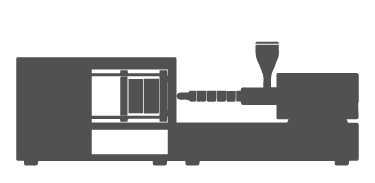
There is a variety of plastic injection molding machines available, and the selection of model is a key to plastic injection molding, because the product to be molded varies in size, weight, and material, and thus the suitable injection molding machines differ. Besides considering the property of the molded product, we recommend that you take the mold opening stroke, clamping force, injection volume, screw compression ratio and injection speed into account as well, to select the most suitable injection molding machine for your product.

Size

Weight

Raw plastic material

Adjustment of Parameters for Plastic Injection Molding
Operator’s skills are crucial to the process of plastic injection molding. The so-called operational skills are actually the setup of controlling injection parameters and the adjustments made at any time. We divide the range of plastic injection parameters to be adjusted into the following five categories: "Temperature", "Pressure", "Speed", "Position", and "Time". Of these, temperature is more particular than the others; it covers the drying temperature, injection barrel heating temperature, mold cooling temperature, etc. to be adjusted, while the other parameters are set and fine-tuned, when appropriate, according to the steps of plastic injection and the injection condition of each product. In the past, skilled operators tended to rely on their feelings or experience in adjusting the machine; however, as technology advances, on today’s injection molding machines, adjustments of parameters can be made based on the data that are transmitted in real time.

Temperature

Pressure

Speed

Position

Time
Process of Plastic Injection Molding
Wei Chen Industrial simplifies the complex plastic injection molding process into five key stages: Plasticizing → Injection → Holding Pressure → Cooling → Ejection.These five stages operate in a continuous cycle throughout production, and when combined with automated manufacturing systems, enable high-efficiency, large-volume production of plastic components with consistent quality and high precision, meeting the diverse needs of various industries.

1.Plasticizing
Plastic pellets are fed into the barrel of the injection molding machine, where they are heated and melted into a molten state.
Operators adjust the processing temperature according to the characteristics of each plastic material to ensure proper melting and prepare for molding.
Operators adjust the processing temperature according to the characteristics of each plastic material to ensure proper melting and prepare for molding.
Key Controls:
Barrel temperature settings, raw material drying, melt uniformity.

2.Injection
The molten plastic is injected into the mold cavity by the screw and initially formed according to the mold design.
Injection speed and pressure are precisely set based on product features and mold conditions to prevent defects such as short shots, flash, or dimensional errors.
Injection speed and pressure are precisely set based on product features and mold conditions to prevent defects such as short shots, flash, or dimensional errors.
Key Controls:
Injection speed, injection pressure, mold temperature, cavity design.

3. Holding Pressure
After filling, continuous pressure is applied to compensate for material shrinkage during cooling.
This ensures the plastic remains compact within the cavity, preventing voids, warping, or backflow, while improving structural strength and dimensional accuracy.
This ensures the plastic remains compact within the cavity, preventing voids, warping, or backflow, while improving structural strength and dimensional accuracy.
Key Controls:
Holding pressure, holding time, shrinkage compensation.

4.Cooling
The molded part is cooled and solidified in the mold to achieve its final shape and structural stability.
Cooling efficiency directly affects production speed and product quality; therefore, molds are equipped with cooling channels to achieve uniform temperature control.
Cooling efficiency directly affects production speed and product quality; therefore, molds are equipped with cooling channels to achieve uniform temperature control.
Key Controls:
Cooling water temperature and flow, cooling time, mold temperature uniformity.

5.Ejection
After cooling, the mold opens and the ejector system removes the finished product. Smooth and balanced ejection is critical to avoid product damage or surface defects.
Key Controls:
Ejection speed and balance, ejector pin design and force, product surface protection.